Why Boutique Dealerships and Showrooms Are Upgrading Their Indoor Vehicle Handling

Walk into any high-end showroom and you’ll notice something immediately: the floors gleam, the lighting is deliberate, and every vehicle looks like it’s posed for a photoshoot. That polish doesn’t happen by accident. Behind the scenes, boutique dealerships and private showrooms work hard to protect that pristine environment, and increasingly, that means rethinking how vehicles actually get moved from one spot to another.

For years, the default solution was simple: have a couple of staff members push the car by hand, or fire up the engine and drive it a few feet. Neither option fits the standards boutique operations hold themselves to. A showroom selling six-figure vehicles can’t afford a scuffed bumper, a scratched floor, or the smell of exhaust drifting past a client mid-conversation. As a result, more dealership managers are investing in purpose-built equipment designed specifically for quiet, precise, indoor vehicle handling.

This shift matters for anyone managing a showroom floor, a private collection, or a boutique consignment space. Below, we’ll look at the hidden costs of traditional moving methods, what to look for in better equipment, and why an electric vehicle mover like the CarCaddy Vehicle Puller is becoming the standard for operations that can’t afford to compromise.

The Hidden Costs of Traditional Moving Methods

Manually pushing a vehicle sounds simple enough, but anyone who has actually done it in a showroom knows how quickly things can go wrong.

Physical risk is the first problem. Pushing a heavy vehicle, especially an exotic or vintage model, requires real effort and coordination. One slip, one uneven push, and you’re looking at a dented bumper, a scraped panel, or a scratched floor. Worse, staff members can strain their backs or suffer other injuries trying to muscle a multi-ton vehicle into position. These incidents aren’t just costly to repair; they can shake a client’s confidence in how carefully their investment is being handled.

Noise and fumes are the second problem, and they’re often underestimated. Starting an engine just to reposition a car a few feet might seem like the easier option, but it introduces noise and exhaust into a space designed to feel calm, clean, and exclusive. Clients browsing a boutique showroom expect a quiet, almost gallery-like atmosphere. A sudden engine roar or a whiff of exhaust breaks that spell instantly, and it can undercut the luxury experience a dealership has worked hard to build.

Taken together, these risks explain why more showroom managers are looking for an alternative that protects both their inventory and their brand image.

Choosing the Right Equipment for Boutique Work

Not all vehicle-moving equipment is built with boutique environments in mind. Traditional floor pushers and towing dollies were designed for utility, not finesse, and it shows.

Traditional floor pushers typically require more manual effort, offer less precise control, and weren’t engineered with delicate positioning in mind. They can work fine in a utilitarian service bay, but they’re a poor match for a showroom floor surrounded by glass walls, polished concrete, and other high-value vehicles parked just inches away.

Precision-controlled equipment, by contrast, is built for exactly this kind of tight, high-stakes maneuvering. A dedicated electric car pusher gives the operator fine control over speed and direction, which matters enormously when you’re threading a vehicle between a showroom window and a neighboring car with little room to spare. For managers responsible for multimillion-dollar inventory, that level of control isn’t a luxury. It’s a requirement.

The right vehicle mover should let a single operator reposition a car confidently, without guesswork and without the risk of overcorrecting into something expensive.

Key Benefits of the CarCaddy for Dealerships

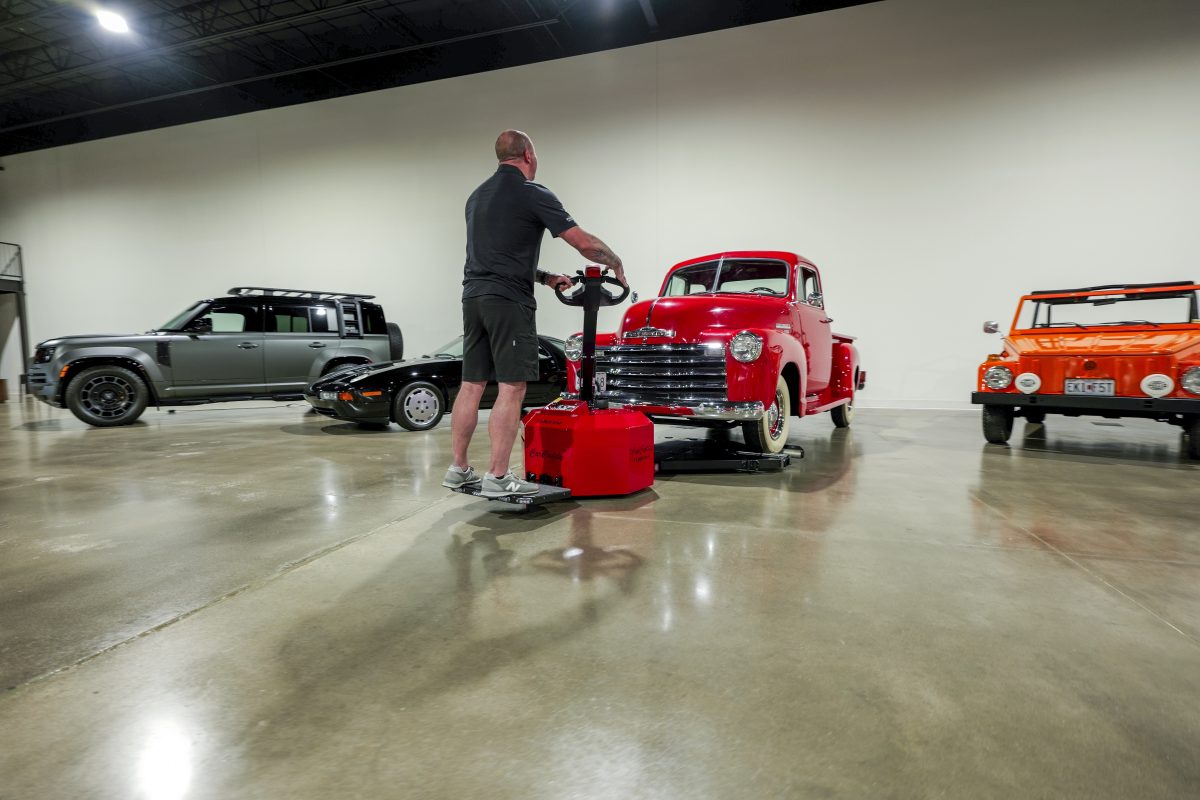
The CarCaddy Vehicle Puller: Collector’s Edition was built with exactly these challenges in mind. It’s a battery-powered, motorized car mover designed for museums, collectors, and classic consignment shops, and it’s rated for vehicles up to 7,000 lb., with front axle weight up to 3,000 lb.

Here’s what that means for a boutique dealership or showroom:

Single-operator convenience. Instead of pulling two or three staff members away from other work to muscle a car into place, one person can operate the CarCaddy and move even heavy exotic or vintage models with ease. That frees up your team to focus on clients instead of logistics.

Zero touch on body panels. The CarCaddy’s roller arms engage the vehicle’s tires rather than its body, so there’s no risk of marring a bumper or panel during positioning. For dealerships handling rare or irreplaceable vehicles, this kind of protection is non-negotiable.

Clean, battery-powered operation. With a 36VDC drive system and a non-marking drive wheel, the CarCaddy moves vehicles without engine noise, exhaust fumes, or floor damage. The non-marking crown caster wheels also help protect polished showroom floors, so the clean, quiet atmosphere clients expect stays intact.

Precise, adjustable control. A high-tech speed controller, neutral throttle braking, and adjustable acceleration and braking give operators fine command over the vehicle’s movement, forward or reverse, at speeds up to 3 mph. Combined with a low-profile design and adjustable roller arms, it’s built to position vehicles within inches of glass, walls, or other cars.

These aren’t hypothetical advantages. Teams at collections and dealerships like Parc Motor Club, Hyman, and the Midwest Car Collection Museum have made the switch specifically because manual methods were slow, labor-intensive, and, in some cases, bordering on unsafe. According to Doug Melon, Curator of the Midwest Car Collection Museum, his team previously relied on multiple people to move cars in confined spaces in a way that felt risky. Classic Auto Repair’s Blake Mullen reported a similar story: what once took two or three team members now takes one, and the vehicles move faster and more confidently than before.

Protect Your Showroom’s Standards with the Right Equipment

Boutique dealerships and showrooms succeed by controlling every detail of the client experience, from the lighting to the layout to the way a vehicle glides into position. Manual pushing methods and loud engine starts work against that goal, introducing risk, noise, and wear that boutique operations simply can’t afford.

Upgrading to a dedicated electric vehicle mover isn’t just about convenience. It’s about protecting your inventory, your staff, and the polished experience your clients expect every time they walk through the door.

If you’re ready to explore which CarCaddy model fits your showroom’s space and vehicle lineup, reach out for a custom consultation. Our team can walk you through vehicle compatibility, available colors, and the features that matter most for your collection.
Top Car Museums in Minnesota & Michigan Every Collector Should Visit

The Midwest doesn’t just build cars — it preserves them. From Minnesota’s quiet collector circuit to Michigan’s sprawling automotive cathedrals, this region holds some of the richest car history in the country. Rusty barn finds became polished showpieces here, and entire museums now exist to keep that heritage alive for future generations.

But preserving a priceless automobile is a different skill than building one. Museum curators face a daily puzzle: how do you rotate multi-million-dollar vehicles through tight showroom floors without risking so much as a scuff? Narrow aisles, polished concrete, and six-figure paint jobs don’t mix well with careless handling.

That challenge is exactly why the smartest museums have quietly changed how they move their cars. Before we get to that, let’s take a tour of some of the finest automotive collections Minnesota and Michigan have to offer.

Top Car Museums in Minnesota

Minnesota’s collector scene runs deeper than most people realize, with private collections and regional displays holding their own against bigger institutions.

Local Historic Displays and Morrie’s Collection-Style Showrooms

Several Minnesota dealerships and private collections showcase rare, vintage models in intimate indoor settings reminiscent of the Morrie’s Collection approach. These spaces prioritize close-up viewing, letting visitors admire original upholstery stitching and factory badging without velvet ropes getting in the way.

The tradeoff? Tight footprints. When a showroom is built for proximity rather than square footage, every inch counts, and every vehicle move carries risk.

Northland Antique Auto Museum and Regional Displays

The Northland Antique Auto Museum represents the backbone of Minnesota’s preservation community, maintaining vintage vehicles in carefully controlled indoor environments. Keeping these displays rotating fresh for repeat visitors means regularly shifting cars in and out of position, often in galleries that were never designed with forklifts or towing equipment in mind.

Regional museums like Northland rely on precision, not horsepower, to keep their collections looking showroom-fresh year after year.

Top Car Museums in Michigan

If Minnesota is the quiet corner of Midwest car culture, Michigan is the main stage. The Motor City’s legacy practically demands museums worthy of its history.

The Henry Ford Museum (Dearborn, MI)

No conversation about American automotive heritage gets far without mentioning The Henry Ford Museum. Spanning hundreds of thousands of square feet, this Dearborn institution houses everything from presidential limousines to the bus where Rosa Parks took her stand. It’s less a museum and more a time capsule of American innovation, with automobiles serving as the connecting thread.

Moving pieces through a collection this significant requires a level of care that goes beyond standard museum handling. One wrong nudge against a one-of-a-kind artifact isn’t just costly — it’s irreplaceable.

Gilmore Car Museum (Hickory Corners, MI)

The Gilmore Car Museum claims the title of North America’s largest auto museum campus, spreading across multiple historic buildings and hundreds of acres. With such an expansive footprint, the Gilmore team manages an enormous volume of vehicle movement, shuttling cars between galleries, event spaces, and seasonal exhibits.

That kind of scale creates its own problem: the more often vehicles move, the more opportunities exist for accidents. Multiply a small risk by thousands of moves per year, and the math stops favoring old-fashioned manual handling.

The Invisible Partner Behind Great Displays

Here’s a question most visitors never think to ask: how does a museum relocate a 1932 Duesenberg without leaving a smudge, a dent, or a lungful of exhaust fumes in the gallery?

The honest answer is that it can’t, not with the old methods. Starting a decades-old engine indoors means fumes, noise, and unnecessary strain on an original powertrain that might not have turned over in years. Pushing a vehicle by hand works until gravity, uneven flooring, or a slippery shoe sends things sideways. Neither option belongs anywhere near a car worth more than most houses.

This is where an electric vehicle mover earns its keep. Rather than relying on the vehicle’s own engine or a crew of straining staff, a motorized car mover like CarCaddy lifts and rolls the car into place using a battery-powered drive system. No ignition required. No exhaust. No white-knuckle moments watching a bumper inch toward a display case.

A few reasons museums are making the switch:

  • Zero emissions indoors. Electric vehicle movers eliminate the need to run an engine inside a climate-controlled gallery, protecting both air quality and the vehicle itself.
  • Controlled, consistent movement. A car pushing machine moves at a steady, adjustable pace, which beats the unpredictability of human muscle on a smooth showroom floor.
  • Reduced contact risk. Features like roller arms and a low-profile platform cradle the vehicle rather than pushing against a bumper or body panel, keeping original trim and paint untouched.
  • Fewer people, less liability. A single trained operator can reposition a vehicle that would otherwise require three or four staff members pushing and spotting.

CarCaddy’s Collector’s Edition was built with exactly this scenario in mind. Rated for vehicles up to 7,000 lb. with front axle weight up to 3,000 lb., it handles everything from compact classics to full-size luxury sedans. The ride-on platform flips up for walk-behind operation in the tightest galleries, while LED lighting keeps the whole operation visible even in dim, moody museum lighting designed to flatter the paint jobs rather than the aisles.

In other words: it’s the stagehand of the car museum world. Nobody applauds the stagehand, but the show doesn’t happen without one.

Protect What You’ve Worked So Hard to Preserve

Minnesota’s intimate showrooms and Michigan’s sprawling campuses have one thing in common: every vehicle inside them is irreplaceable. A scratched fender or a dented rocker panel isn’t just an inconvenience — it’s a permanent mark on history.

If your museum, collection, or boutique dealership is still relying on hand-pushing or risky engine starts to reposition vehicles, it might be time for an upgrade that matches the value of what you’re protecting.

Check out CarCaddy’s full specifications to see which configuration fits your collection, and when you’re ready, hit the Get Now button to bring one home.

Still have questions about weight ratings, platform sizing, or how CarCaddy fits into your specific gallery layout? Our product engineers are happy to walk through the details with you. Fill out our contact form, and let’s figure out exactly how CarCaddy can keep your collection rolling — safely, quietly, and without a single unwanted bump along the way.