Moving Millions in Silence: What Jay Leno’s Garage Teaches Us About Showroom Safety

Few garages on earth carry the same weight—literally and figuratively—as Jay Leno’s Big Dog Garage in Burbank, California. With over 181 cars and 160 motorcycles, collectively valued at an estimated $53 million, Leno’s collection is less a hobby and more a living museum. Every vehicle is a runner, not a display piece. And every vehicle, at some point, needs to be moved. 

That’s where things get complicated. 

For automotive museum managers, private registry curators, and boutique dealerships housing rare and irreplaceable vehicles, moving cars around a facility is one of the highest-risk, most under-appreciated tasks in the business. It happens daily. It rarely makes headlines—until something goes catastrophically wrong. 

The Financial Stakes Are Higher Than Most People Realize

Managing an elite collection isn’t just about aesthetics. It’s about liability. When a single car in your facility is worth $20 million, every movement becomes a calculated risk. 

The crown jewel of Leno’s collection is his 1934 Duesenberg Walker Coupe—an absolute one-of-one aerodynamic marvel, custom-built in the 1930s for a pharmaceutical tycoon, and never replicated. There is no parts catalog for a car like this. No second chance if the bodywork gets dented. No insurance payout that restores irreplaceable pre-war metalwork or the provenance attached to original paintwork. 

Behind the Duesenberg sits his 1994 McLaren F1—one of only 106 ever produced—currently valued at $12 million. Then there’s the 1963 Chrysler Turbine Car, the 1967 Lamborghini Miura P400, the 1928 Bentley Speed 6, and early steam-powered vehicles that pre-date modern automotive engineering by decades. 

Each of these vehicles presents its own set of logistical challenges. Each one is irreplaceable. 

Why Hand-Pushing Is Never the Right Answer 

Here’s a scenario that plays out in garages and showrooms more often than it should: a curator needs to shuffle a car three feet to the left to make room for an incoming vehicle. There’s no key, or the battery is dead, or—more critically—the vehicle simply should not be started for a quick reposition. So the team gathers around, places hands on body panels, and pushes. 

For vehicles like the early steam-powered cars in Leno’s collection, or experimental models like the Chrysler Turbine, starting the engine for a minor repositioning isn’t just inconvenient—it can be genuinely harmful to the vehicle and dangerous for the crew. But a five-man push introduces its own set of risks: uneven force distribution, accidental contact with fragile paint, one misstep near a low-clearance bumper, or a crew member losing their footing on a polished concrete floor. 

On a $20 million car, a single handprint pressed into 90-year-old lacquer during an awkward push is not a minor incident. It’s a disaster. 

The Mechanical Diversity Problem in Elite Collections 

Part of what makes collections like Leno’s so extraordinary is their range. You might have a modern carbon-fiber supercar parked beside a century-old steam vehicle. A turbine-powered experimental prototype adjacent to a classic Lamborghini Countach. 

These vehicles do not share the same weight distribution, suspension geometry, or structural tolerances. They require a repositioning solution that adapts to them—not the other way around. That’s precisely the gap that a purpose-built electric vehicle mover fills. 

Rather than relying on human judgment and grip strength, a dedicated car pushing machine engages directly with the tires, applying smooth, controlled force at the safest possible contact point. No body panel contact, no improvised leverage, and no risk of a crew member losing their footing mid-push. 

Why CarCaddy Is the Right Tool for High-Value Collections 

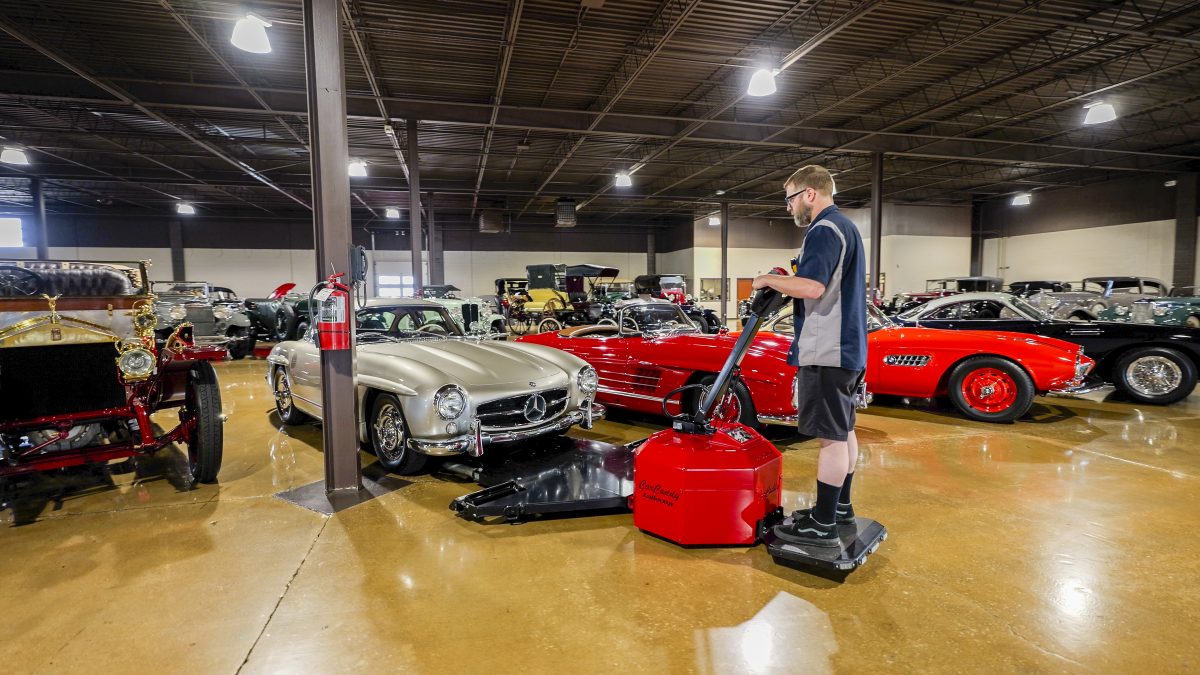
CarCaddy is an American-made electric vehicle mover engineered specifically for environments where precision and protection are non-negotiable. Designed for museums, private collectors, and boutique dealerships, the CarCaddy handles vehicles up to 7,000 lbs with controlled, battery-powered movement—safely, quietly, and without exhaust fumes that could contaminate a closed showroom or storage facility. 

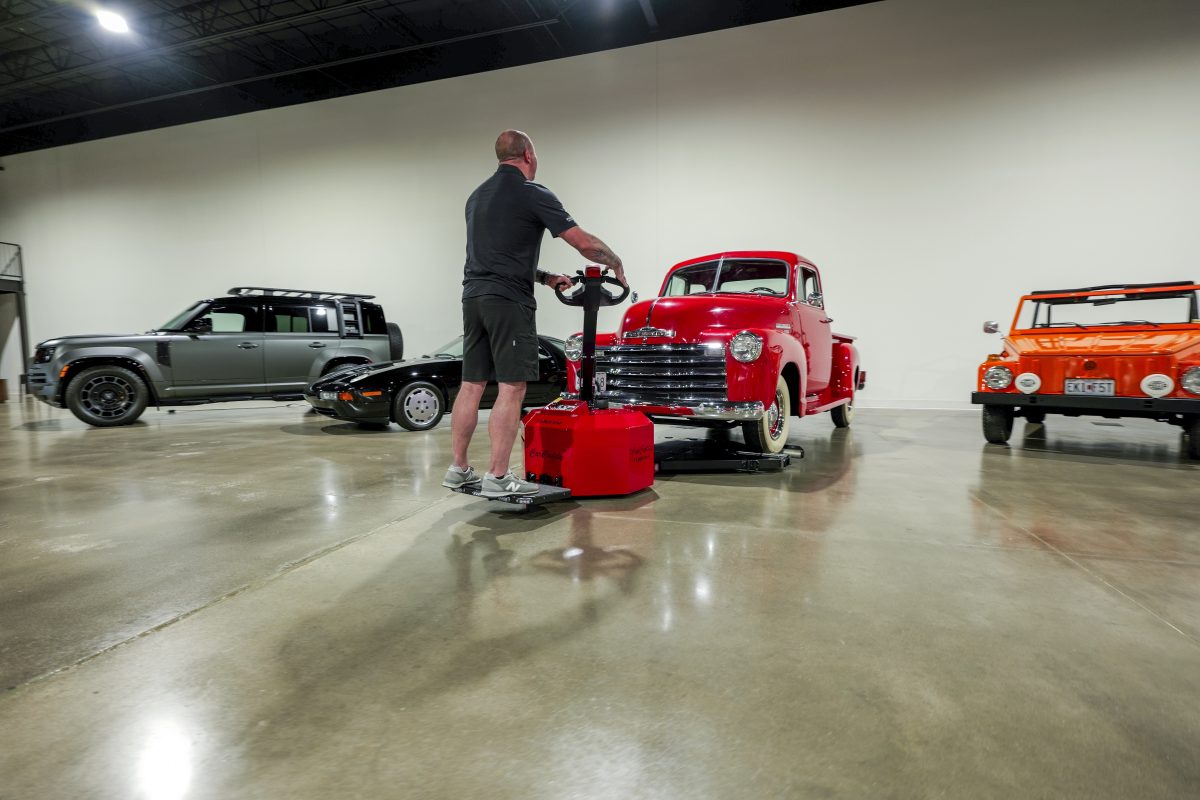
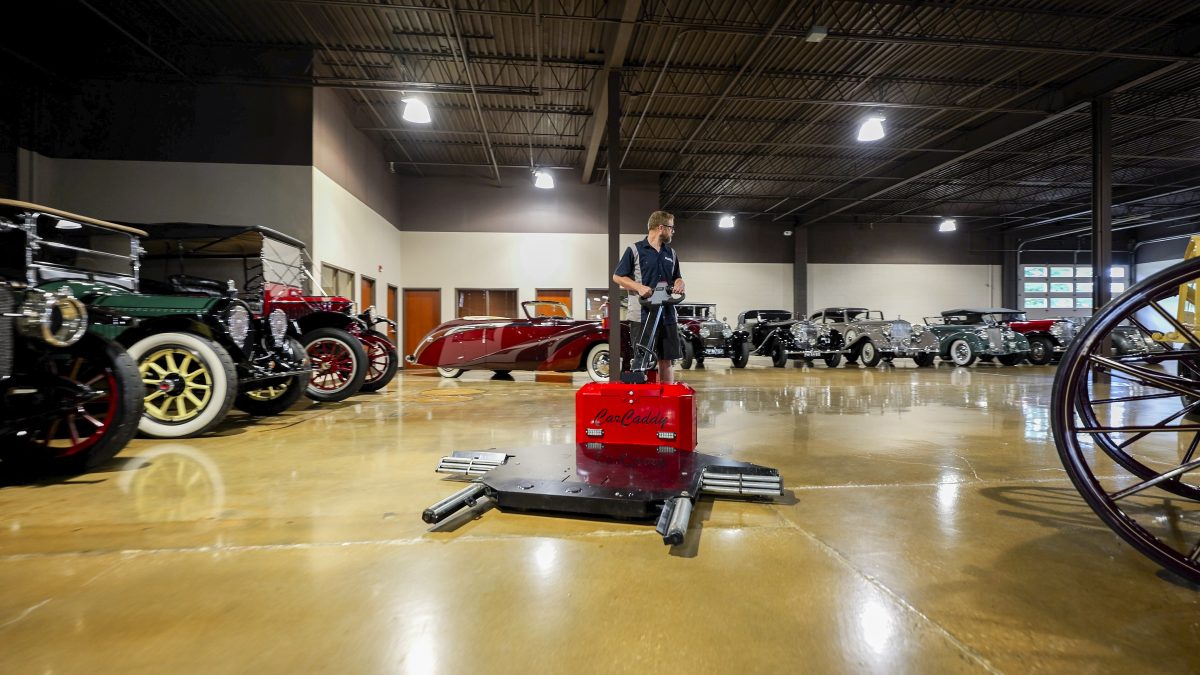
A single operator controls the CarCaddy from an ergonomic ride-on or walk-behind platform, with a variable roller arm system that adjusts for loading and unloading of almost any vehicle. The non-marking drive wheels and crown caster wheels ensure no contact marks are left on delicate flooring—an important detail in facilities housing multi-million dollar collections. 

Unlike competitors such as Stringo or Power Pusher, the CarCaddy is built with a low-profile design that works in tight showroom configurations without requiring costly facility modifications or a large operational footprint. The 36V three-battery drive system delivers smooth, adjustable acceleration and neutral throttle braking—meaning the operator stays in complete control, even when maneuvering a historically significant vehicle in a confined space. 

For facilities where repositioning happens regularly, this isn’t a luxury. It’s the right way to operate. 

The Standard You Set Reflects the Collection You Keep 

A $53 million collection doesn’t stay valuable by accident. It stays valuable because every decision—every restoration, every storage arrangement, every repositioning—is made with the long-term integrity of the vehicle in mind. 

Automotive museums and private curators who operate at this level understand that the tools you use to move vehicles reflect the standard of care you bring to everything else. A manual push is a judgment call made under pressure. An electric car pusher is a system built for precision. 

The difference between the two shows up not in the moments where nothing goes wrong—but in the moments where it almost does. 

Ready to Protect What You’ve Built?

At CarCaddy, we work with museum managers, private collectors, and dealership operators who take vehicle safety seriously. Our team of product engineers understands the unique challenges of moving rare, dead-battery, or structurally sensitive vehicles through tight spaces—and we’re ready to help you find the right configuration for your facility. 

Visit carcaddyvehiclepuller.com to review the full specifications for the CarCaddy Collector’s Edition. Then complete the contact form to connect directly with one of our product engineers. We’ll walk you through the options, answer your questions, and make sure you have the right vehicle mover for the collection you’ve worked hard to build. 
Preserving History: Why Museums Trust the CarCaddy

Ask any museum curator about their job, and you’ll hear a familiar mix of pride and pressure. They aren’t just dusting display cases. They’re the guardians of history—and when that history happens to be a 1962 Ferrari 250 GTO or a one-of-a-kind concept car from the 1930s, the stakes climb into the millions. 

Caring for rare, vintage, and historically significant automobiles is a privilege. It’s also a daily test of patience, planning, and precision. These vehicles weren’t built to last forever, yet curators are tasked with keeping them pristine for generations to come. Every decision matters, from climate control to lighting to the gentle hands that touch the paint. 

And then there’s the part nobody warns you about: actually moving the cars. It sounds simple. It’s anything but. 

The Hidden Risk in Moving Priceless Cars 

Picture a packed exhibit hall. Display pedestals everywhere. Velvet ropes. Glass cases just inches from priceless fenders. Now imagine you need to shift a multimillion-dollar automobile three feet to the left for a new exhibit layout. How do you do it without putting the car—or your staff—at risk? 

Curators face two bad options, and both come with real consequences. 

Option one: start the engine.

It seems logical. The car has a motor, so why not use it? Because firing up a rare, decades-old engine just to roll a few feet causes genuine harm. Old seals dry out. Fuel systems gum up. Fragile components wear down with every unnecessary ignition. You’re trading long-term preservation for short-term convenience—a terrible deal when the engine itself is part of what makes the car valuable. Many of these vehicles haven’t run in years, and for good reason. 

Option two: push it by hand.

This is where things get dangerous. Manual pushing invites human error in the worst possible setting. One slip, one misjudged angle, and you’ve got a dented panel, a scratched bumper, or a car that’s rolled into a display stand. Then there’s the human cost. Pushing a 4,000-pound vehicle strains backs, pulls muscles, and turns a routine task into an injury report. 

Neither choice protects what matters most. Curators deserve a third option—one built for delicacy, not damage. 

A Smarter Way to Move Multimillion-Dollar Vehicles 

That’s exactly why the CarCaddy exists. It’s an electric vehicle mover designed for high-value environments where mistakes simply aren’t an option. 

Here’s what sets it apart. The CarCaddy pulls vehicles up to 7,000 pounds easily, safely, and efficiently—without ever touching the engine. No ignition, no wear, no fumes. The car stays exactly as it should: silent, preserved, and protected. For a museum, that peace of mind is worth its weight in gold. 

Size is where the CarCaddy really shines. Its low-profile, compact design lets staff maneuver expensive vehicles around tight corners and snug display pedestals with confidence. You’re not wrestling with a bulky industrial machine meant for a factory floor. You’re working with a tool that respects the space—and the cars—around it. 

A few features make it especially well-suited to museum work: 

• 7,000 lb. pulling capacity for handling everything from lightweight classics to heavier vintage models 

• 36V electric drive system with a non-marking drive wheel, so your floors stay flawless 

• Variable adjustable arms that load and unload almost any vehicle with ease 

• Zero emissions, keeping the air clean around irreplaceable collections 

• Smooth 0–3 mph forward and reverse control for slow, deliberate movements in tight quarters 

• Non-marking crown caster wheels that won’t leave a trace on polished gallery floors 

There’s also the matter of looks, which collectors and curators appreciate more than most. The Collector’s Edition comes in standard Ferrari Red, with options like Matte Black and Gold, Baby Blue, Silver, and more. It’s a piece of equipment that earns its place beside the cars it serves. As the team behind it puts it, “Let us know if we need to match a certain vehicle or collection and we will do it!” 

Built in America and backed by a technical service team that ships parts the same day, the CarCaddy is ready to work when work needs doing. That reliability counts when you’re responsible for the irreplaceable. 

Why Compact Design Beats Heavy-Duty Muscle

It’s tempting to assume bigger means better when it comes to moving vehicles. In a museum, the opposite is true. Heavy-duty industrial movers are built for brute force—useful on a loading dock, risky around a glass display case. 

Preservation calls for finesse. The cars in your care are delicate, valuable, and often one of a kind. They need a tool that moves them with the same care a conservator brings to a centuries-old painting. The CarCaddy’s strength is its control. It does the heavy lifting while your staff stays in command, gliding a priceless vehicle into place without strain, fumes, or fear of a costly mistake. 

That’s the difference between moving cars and protecting them. 

Upgrade Your Preservation Toolkit

Museum directors invest heavily in keeping their collections safe—climate systems, security, lighting, and expert staff. Yet one of the most common risks to a vehicle happens in the simple act of moving it. The right equipment closes that gap. 

If your team is still starting engines or pushing priceless automobiles by hand, it’s time for a better approach. The CarCaddy gives you a way to move your collection with the care it deserves, protecting both your vehicles and the people who look after them. 

Your cars have already stood the test of time. Give them a mover built to keep it that way. Visit the CarCaddy website to learn more, explore color options, and find the right fit for your collection. 

Breathe Easy: The Eco-Friendly Way to Navigate Enclosed Automotive Spaces

Moving vehicles inside a showroom, detailing booth, or museum brings a problem most shop owners know all too well. You need to reposition a car, but firing up the engine fills the space with exhaust fumes. Or worse, you bring in a gas-powered piece of equipment that rumbles, smokes, and chokes the air your staff and customers breathe.

There’s a better way to handle indoor vehicle moving, and it doesn’t involve cranking an engine just to shift a car 50 feet. After years of building vehicle moving solutions for auto shops, dealerships, and manufacturers, we’ve seen how the right equipment transforms a space. Electric tugs like the CarCaddy vehicle mover lets you move heavy vehicles cleanly, quietly, and safely—without any of the downsides that come with gas or diesel machinery.

In this post, we’ll walk through why going electric makes sense for enclosed spaces, and how it protects your air quality, your employees, and your bottom line.

The Hidden Danger of Running Engines Indoors

Let’s start with the most serious issue: air quality. Running gas or diesel vehicles inside a closed building creates dangerous carbon monoxide buildup. This colorless, odorless gas can make your team sick fast, and prolonged exposure is a genuine health hazard. Add the foul smell of exhaust, the lingering soot, and the risk of oil leaks, and you’ve got an environment that’s far from ideal for staff or guests.

Then there’s the noise. Cranking up a vehicle just to move it across the floor is loud and disruptive. Picture a salesperson trying to close a deal while an engine roars in the background. Or a customer consultation interrupted by the rumble of machinery. These small disruptions add up, and they don’t reflect well on your business.

For shops, dealerships, and detailing studios that pride themselves on a clean, professional setting, gas-powered machinery indoors simply works against you.

Silent, Clean, and Powerful

This is where an electric tug changes everything.

The CarCaddy Vehicle Mover runs on a whisper-quiet electric motor. You can move cars during your busiest hours without interrupting a single sales conversation or customer consultation. No engine noise. No shouting over machinery. Just smooth, controlled movement that keeps your floor calm and professional.

Just as important, the CarCaddy is 100% electric and produces zero emissions. That means:

  • No exhaust fumes filling your showroom or studio
  • No carbon monoxide buildup putting your team at risk
  • No oil leaks or soot staining your floors
  • No lingering odors that drive customers away

The result is a cleaner, healthier space for everyone who walks through your doors. And the CarCaddy Vehicle mover doesn’t sacrifice power to get there. It pushes vehicles up to 10,000 lbs. on a flat surface, with a heavy-duty upgrade available for vehicles up to 30,000 lbs. You get the muscle you need without the mess.

The soft, adjustable push pad is gentle on bumpers, protecting your customers’ vehicles from scratches and dents. Non-marking tires keep your floors pristine. Every detail is built with clean, careful indoor operation in mind.

Battery Life Built for the Job

A clean machine is only useful if it’s reliable, and the CarCaddy is built to keep going all day.

The unit runs on a dependable 36V, three-battery system. This setup delivers steady power for continuous indoor use, so your team isn’t left waiting for a charge in the middle of a busy shift. A built-in battery gauge lets you check the charge level at a glance, so there are no surprises.

Charging couldn’t be simpler. The heavy-duty external charger plugs right into a standard 120VAC single-phase outlet—the same kind you already have in your shop. No special wiring. No complicated setup. Just plug it in, let it charge, and get back to work.

For businesses that need even more uptime, an onboard charger and maintenance-free battery options are also available.

Perfect for Pristine Environments

Some spaces demand spotless air and total quiet. The CarCaddy is right at home in:

  • Air-conditioned showrooms where clean air and quiet conversations matter
  • Detailing booths where a single speck of soot can ruin hours of work
  • Automotive museums where preserving both vehicles and atmosphere is the whole point

On top of its clean operation, the CarCaddy offers sleek aesthetic options that let it blend seamlessly into luxury public environments. It looks the part, so it won’t clash with the polished setting you’ve worked hard to create.

Create a Cleaner, Safer Space for Your Business

Create a cleaner, safer, and quieter environment for both your clients and your staff. As a family business, we take pride in manufacturing clean, efficient solutions that elevate your daily operations.

Go electric, go quiet, and go safe with the CarCaddy Vehicle Mover.

The Heavyweight Champions: How to Safely Move “Dead” Electric Vehicles

Electric vehicles have changed everything about modern automotive service—and not just what’s under the hood. When a dead or unpowered EV rolls into your shop, the challenges start before you even lift a wrench. These machines are heavier, more sensitive, and far less forgiving than their gas-powered counterparts. Moving them the wrong way can cost you far more than the repair job itself. This is where the CarCaddy electric vehicle puller shines.

This post breaks down exactly why dead EVs demand a different approach, what’s at risk when you get it wrong, and how the CarCaddy Electric Vehicle Puller gives your team the precision and power to handle them safely, every single time.

Why Dead EVs Are a Different Animal

The shift to electric vehicles hasn’t just changed how cars are powered—it’s changed how much they weigh. A Tesla Model S tips the scales at around 4,900 lbs. A GMC Hummer EV? Nearly 9,000 lbs. Even mid-range electric crossovers routinely land between 4,500 and 6,000 lbs, all because of the enormous lithium-ion battery packs required to power them.

That weight is the first problem. When an EV’s battery is depleted or the system is completely shut down, you can’t rely on the vehicle’s own power-assisted systems to help. The brakes are heavier to engage. The steering offers no assistance. And pushing or maneuvering a 6,000-lb vehicle by hand through a service bay isn’t just inefficient—it’s a serious injury risk for your technicians.

The second problem is less obvious, but potentially far more expensive.

Protecting Sensitive EV Drivetrains: The Back-EMF Risk

Here’s something many shop owners don’t know until it’s too late. Pushing or improperly towing an electric vehicle—even a short distance—can damage the drivetrain. The reason comes down to physics.

Electric motors work in both directions. When electricity flows in, the motor spins the wheels. But when the wheels spin while the motor is unpowered, the motor acts like a generator, producing what’s called back-EMF (back electromotive force). Without the vehicle’s control systems active to regulate this, the voltage generated can spike and damage the inverter, the motor windings, or other sensitive electronics. According to automotive engineers and EV forums, flat-towing an EV—or dragging it with its driven wheels rolling on the ground—is a well-documented cause of inverter failure.

Dual-motor drivetrains are particularly vulnerable. With motors on both axles, any uncontrolled wheel spin during an improper tow creates simultaneous back-EMF at the front and rear. Add regenerative braking systems into the mix, and the risk of expensive electronic damage multiplies further.

The solution isn’t to push harder or pull more carefully. The solution is to take the driven wheels completely out of the equation.

How the CarCaddy Protects Your EVs and Your Bottom Line

The CarCaddy electric vehicle puller is specifically designed for exactly this scenario. Rather than pushing or dragging the vehicle from behind—or rolling it on its own driven wheels—the CarCaddy uses hydraulic roller arms to cradle the front tires and lift them off the ground entirely.

That single design decision changes everything.

With the front wheels suspended, the drive axle doesn’t rotate. No wheel spin means no unintended motor activation. No motor activation means no back-EMF. Your customer’s EV drivetrain stays completely undisturbed, and you avoid the kind of repair bills that can turn a standard service job into a warranty nightmare.

The CarCaddy VP 7K handles vehicles up to 7,000 lbs.—more than enough for most luxury EVs currently on the road. The hydraulic dual tire engaging system loads the vehicle smoothly, without the straps, hooks, or rubber push pads that create contact points on bumpers and body panels. For shops working with high-value electric vehicles, that level of care matters enormously.

Power and Precision to Match EV Weight

Moving a 6,000-lb vehicle through a busy service bay requires more than raw pulling strength. It requires control.

The CarCaddy’s 36VDC drive system—running on a three-battery configuration—delivers steady, reliable power without sudden torque spikes that could send a heavy EV rolling out of position. Variable speed thumb control lets your technician dial in exactly the right pace for the situation, whether that’s a slow, careful crawl through a tight bay door or a more efficient repositioning across an open floor.

Neutral throttle braking is one of the features that makes the biggest practical difference on the shop floor. The moment a technician releases the throttle, the unit stops. There’s no coasting, no drift, no momentum carrying a multi-ton EV somewhere it shouldn’t go. Combined with an emergency safety stop switch, the CarCaddy gives a single operator full, confident control over a vehicle that would otherwise require four or five people to nudge manually—and even then, not safely.

The walk-behind design makes it equally manageable in confined spaces. Standard service bays weren’t built with 7,000-lb electric trucks in mind, but with the CarCaddy’s electric vehicle puller’s maneuverability, your team can navigate those same bays without modification or risk.

Future-Proof Your Shop for the EV Revolution

EVs aren’t a niche market anymore. They’re the direction the entire industry is heading, and shops that aren’t equipped to handle them safely and efficiently will fall behind fast. Injury claims from manual vehicle handling, drivetrain damage from improper towing, and bottlenecked service bays are all avoidable problems—but only if you have the right equipment.

Our family business engineered the CarCaddy to handle the heaviest modern vehicles with absolute precision and zero strain on your team. One technician. One unit. Full control over a vehicle that weighs as much as a small truck.

Contact us today for a free price quote, and let’s make sure your shop is ready for every EV that rolls through your door.

CarCaddy: The Safe Vehicle Mover for Car Collections

Step inside a world-class car collection and you’ll notice the details first. The floors gleam like glass. Climate controls hum quietly in the background, holding the air at a perfect temperature. And the cars—each one a work of art—sit in flawless rows, their paint reflecting the soft gallery lighting like polished mirrors. 

This is the standard for serious collectors, private museums, and boutique dealerships. Everything about the space says care, precision, and pride. But there’s one moment in the life of any collection that puts all of that at risk: the moment you need to move a car. 

If you manage rare vehicles, you already know that moving them is rarely as simple as turning a key. That’s where the right vehicle mover becomes essential. In this post, we’ll look at why traditional methods fall short, and how CarCaddy gives you a safer, smarter way to move any car in your collection. 

The Hidden Risk of Moving Priceless Cars

Many of the vehicles in a high-end collection don’t run. Some are vintage classics with delicate engines that owners prefer to keep dormant. Others are works in progress, between restorations, or simply too valuable to start up for a short repositioning. So when it’s time to rearrange the floor or load a car for transport, the old solution comes out: gather a few people and push. 

It sounds harmless. It isn’t. 

Manually pushing a rare supercar or a delicate classic invites a long list of problems: 

  • Paint and body damage. All it takes is one hand in the wrong place, a belt buckle against a fender, or a careless lean to scratch finishes that cost thousands to restore. 
  • Bumper and trim stress. Pushing against a vintage bumper or fragile trim piece can crack, dent, or warp components that may be impossible to replace. 
  • Chassis strain. Uneven force from several people pushing at different angles can stress a frame that was never built for that kind of pressure. 
  • Personal injury. Cars are heavy. A slope, a slick floor, or a momentary loss of control can turn a routine move into an accident. 

For a collection where a single vehicle may be worth more than a house, the math is simple. The risk far outweighs the convenience. 

Why Industrial Pushers Aren’t the Answer

Some facility managers turn to industrial dealership pushers to solve the problem. These machines are built for car dealerships and repair shops, where the goal is to drag broken-down vehicles across a lot quickly. They get the job done, but they were never designed with rare cars in mind. 

These heavy-duty tools tend to be bulky, aggressive, and rough on finishes. They can leave marks on floors, handle vehicles without much finesse, and look completely out of place in a pristine gallery setting. When every car on your floor is a masterpiece, you need equipment that treats it that way. 

How CarCaddy Treats Every Car Like a Masterpiece

CarCaddy was built for a different mission. The Collector’s Edition is an American made vehicle mover designed specifically for museums, classic consignment shops, and private collectors. It lets a single person gently control, guide, and park any car in the collection—no crew, no pushing, no risk. 

Here’s what sets CarCaddy apart: 

  • A low-profile design. The compact, sleek build slides into tight spaces and works comfortably in galleries where room is limited and appearances matter. 
  • Variable adjustable arms. Roller arms adjust to fit almost any vehicle, making loading and unloading smooth and secure across your entire collection. 
  • Smooth, precise control. A 36VDC drive system with a high-tech speed controller, neutral throttle braking, and adjustable acceleration delivers slow, deliberate movement at 0–3 mph forward and reverse. 
  • Floor-friendly wheels. Non-marking drive and crown caster wheels protect your spotless floors as carefully as they protect your cars. 
  • Built for visibility. LED lighting and hi-beam headlights make “grab and go” simple, even in dim corners of the facility. 
  • Flexible operation. A lighted rider platform flips up and down, so you can ride along or walk behind depending on the job. 

The result is a vehicle mover that does the work of several people, controlled safely by one. No strained backs. No nervous pushing. No holding your breath as a seven-figure car inches across the floor. 

Form That Matches Function

A great collection is about beauty as much as value, and CarCaddy fits right in. The Collector’s Edition comes standard in Ferrari Red with molded handlebars, but the color options don’t stop there. Choose from Baby Blue, Matte Black and Gold, Pink, Silver, or White to complement your space. 

Want it to match a specific vehicle or your collection’s signature look? Just ask. The CarCaddy team will work to match a particular color so your vehicle mover looks every bit as intentional as the cars it moves. In a room full of design icons, your equipment should look the part too. 

Support That Keeps You Running

Owning rare cars means valuing reliability, and the same goes for the tools that move them. CarCaddy backs its product with a technical service team that’s readily available, plus same-day parts shipping. When work needs doing, your vehicle mover is ready to do it. That kind of dependable, hands-on support gives collectors and facility managers one less thing to worry about. 

Your Collection Deserves the Highest Level of Care

You’ve invested years and significant resources into building a collection worth admiring. Every detail of your facility reflects that commitment—from the climate control to the spotless floors to the careful placement of each vehicle. The way you move those cars should reflect the same standard. 

CarCaddy makes a one-person move not just possible, but effortless and safe. It protects your vehicles, your floors, your staff, and your peace of mind, all while looking right at home in even the most beautiful gallery. 

Ready to see how easy a one-person move can be? Visit the CarCaddy Vehicle Puller website to watch the product in action and review the full specifications. When you’re ready to talk details, fill out our contact form and one of our product engineers will be happy to discuss the right setup for your collection. Your cars are masterpieces—let’s move them like masterpieces. 

Inside the World’s Largest Car Collection ($5 Billion) 

Tucked away in the small, oil-rich nation of Brunei sits a car collection so vast it sounds more like a tall tale than a fact. The man behind it is Sultan Hassanal Bolkiah, and his garage isn’t just big—it’s the largest private vehicle collection on the planet. 

How large, exactly? We’re talking about more than 7,000 cars, with an estimated value of roughly $5 billion. To put that in perspective, that’s enough vehicles to fill multiple football stadiums, and a price tag that rivals the GDP of some small countries. For anyone who manages a museum, owns a high-end collection, or runs a boutique dealership, the Sultan’s garage is the ultimate daydream. 

But behind the dazzling figures lies a question most car lovers never stop to ask: how do you actually move, store, and care for thousands of irreplaceable vehicles? Let’s take a look inside this incredible collection—and what it teaches the rest of us about handling priceless cars. 

A Collection Like No Other 

The Sultan’s collection reads like a wish list torn from the pages of every automotive magazine ever printed. Hundreds of the cars are custom-built, one-off creations that simply don’t exist anywhere else in the world. 

Among the headliners: 

  • Ferraris built to order, including models the public never had the chance to buy. 
  • Rolls-Royces crafted to exacting personal specifications. 
  • McLarens engineered as one-of-a-kind machines. 

These aren’t cars you can replace with a quick call to a dealer. Each one is unique, which means the value isn’t only measured in dollars—it’s measured in rarity. Damage one of these vehicles, and there’s no second copy waiting in a warehouse somewhere. That reality changes everything about how a collection like this must be managed. 

The Real Challenge: Moving the Unmovable

It’s easy to be wowed by the numbers. The harder story is the day-to-day logistics. When your inventory includes thousands of priceless, often non-running show cars, you can’t simply hop in and drive each one across the floor. 

Many high-value collector cars spend most of their lives parked. Some are display pieces that may not even start without extensive prep. Others are so valuable that owners refuse to put unnecessary miles or wear on the engine and drivetrain. So how do you reposition a car that you’d rather not start, drive, or risk? 

This is the quiet problem that every serious collection faces, whether it holds 7,000 cars or 20: 

  • Tight spaces. Showrooms and storage facilities are designed to fit as many cars as possible, leaving little room to maneuver. 
  • Delicate vehicles. One careless push or bump can cause damage worth more than most people’s homes. 
  • Frequent rearranging. Museums rotate exhibits, dealerships restage their floors, and private owners shuffle vehicles for cleaning, maintenance, and events. 

Moving a single car by hand can take several people, plenty of effort, and a fair amount of risk. Multiply that across an entire collection, and the challenge becomes enormous. 

Why Careful Handling Matters More Than Ever

For collectors and curators, the stakes go beyond simple repairs. A scratched fender or a dented panel on a one-off Ferrari isn’t just a cosmetic issue—it’s a permanent loss of value and history. 

Consider what’s truly at risk when moving high-end vehicles: 

  • Financial value. Repairs on rare cars can run into six or seven figures, if the right parts even exist. 
  • Authenticity. Original paint and panels matter to serious collectors. A repaint can lower a car’s worth significantly. 

The Sultan of Brunei’s collection is the extreme example, but the lesson applies to everyone in the business. When the cars in your care can’t be replaced, the way you move them matters just as much as the way you store them. 

A Smarter Way to Move Priceless Cars

This is exactly the problem we set out to solve at CarCaddy. We build vehicle pulling equipment designed to move cars safely and easily—without starting the engine, risking the drivetrain, or relying on a crew of people to push. 

With CarCaddy, a single person can reposition a vehicle with confidence and control. That means: 

  • Less risk of accidental damage to rare, irreplaceable cars. 
  • Less labor required to rearrange a showroom, museum floor, or private garage. 
  • More flexibility to make the most of tight storage spaces. 

Whether you’re caring for a handful of treasured classics or managing a fleet that would make even the Sultan take notice, the principle is the same. Your cars deserve to be handled with the same care that went into building them. 

Move Your Collection With Confidence

You don’t need 7,000 cars to appreciate the value of moving each one safely. If you manage a car museum, own a high-end collection, or run a boutique dealership, CarCaddy can help you protect your investment every time a vehicle needs to be repositioned. 

We’d love to show you how it works. Visit our website to explore the full product specifications and see CarCaddy in action. When you’re ready to talk details, complete our contact form and one of our product engineers will reach out to answer your questions and help you find the right solution for your collection. 

Your cars are one of a kind. Make sure the way you move them is too. 

The Art of the Effortless Move: Why High-End Collections Deserve Better Than a Five-Person Push

Imagine this: A pristine, multi-million-dollar classic rolls into your showroom or private gallery. The paint is flawless, the chrome gleams under the LED lights, and the historic value is irreplaceable. But it needs to be repositioned.

Suddenly, the luxury atmosphere evaporates. You have to round up four or five staff members. Someone’s leaning on a vintage fender. Another person is precariously close to a custom bumper. Everyone is sweating, breathing heavily, and praying nobody’s belt buckle scratches the clear coat. It looks disorganized, it risks catastrophic damage, and frankly, it just doesn’t match the sophisticated aesthetic of a high-end automotive space.

Your vehicles are masterpieces. Moving them shouldn’t look like a high school gym class project.

Enter the CarCaddy Vehicle Puller: The Collector’s Edition. Engineered right here in the USA by DJ Products in Minnesota, this sleek machine is completely redefining how boutique dealerships, car museums, and private collectors manage their investments. It turns a stressful, multi-person chore into a silent, flawless, one-person operation.

Precision Engineering for Priceless Assets

When you are dealing with rare vintage vehicles, exotic supercars, or high-end luxury inventory, traditional moving methods simply don’t cut it. Pushing cars manually or using clumsy, industrial-grade tow equipment poses serious liabilities.

The CarCaddy Collector’s Edition was built specifically to eliminate those risks. Here is how the engineering keeps your vehicles pristine:

Zero Bumper or Body Contact: The CarCaddy features a brilliant, low-profile design with variable adjustable roller arms. It gently grips and secures the tires, completely bypassing the delicate bodywork, low-hanging front splitters, and vintage bumpers.

Impeccable Maneuverability: Operating in tight showroom spaces or packed gallery floors requires surgical precision. With its advanced Wagon Wheel steering and an angled control panel with molded handlebars, a single operator can guide a vehicle around tight corners and into exact positions with zero physical strain.

Total Speed Control: Mechanical jerks can damage transmissions or cause vehicles to roll unexpectedly. The CarCaddy utilizes a high-tech speed controller that allows smooth, variable acceleration from 0 to 3 mph in both forward and reverse. Coupled with adjustable acceleration/braking and a neutral throttle braking system, the machine stops safely the moment the operator lets go.

Power That Operates in Total Silence

Industrial gas-powered tugs are loud, exhaust-heavy, and completely ruin the refined ambiance of a luxury dealership or museum.

The CarCaddy runs on a clean, whisper-quiet 36VDC drive system powered by a robust three-battery setup. It delivers an impressive 7,000 lb. vehicle towing capacity and handles a 3,000 lb. front axle weight effortlessly—all without a single drop of exhaust or loud engine revs.

Even your pristine showroom floors are protected. The machine is outfitted with non-marking drive wheels and non-marking crown caster wheels. You get all the mechanical muscle you need without leaving a single scuff mark behind.

Performance Capability

Max Vehicle Weight Up to 7,000 lbs

Max Front Axle Weight  Up to 3,000 lbs

Drive System 36VDC with external battery charger

Speed Range 0–3 mph (Variable Forward/Reverse)

Safety Features Neutral throttle braking & safety stop switch

Bespoke Aesthetics: Because Form Follows Function

If you have spent hundreds of thousands of dollars designing a state-of-the-art showroom, a historic museum gallery, or a private luxury garage, the last thing you want is a piece of ugly, industrial orange warehouse equipment sitting in the corner.

The CarCaddy Collector’s Edition is designed to look just as premium as the vehicles it moves. It boasts a sleek, low-profile silhouette, brilliant LED high-beam headlights for crisp visibility, and a lighted rider platform that conveniently flips up or down depending on whether you want to ride or walk the machine.

Best of all? It is entirely color customizable.

While it comes standard in an eye-catching Ferrari Red, DJ Products can custom-paint your CarCaddy to match your specific branding, your facility’s interior design, or even a standout vehicle in your collection. Whether you want a sophisticated Matte Black with Gold accents, a classic Silver, an elegant White, or a custom Baby Blue, this machine integrates seamlessly into luxury spaces. To put it simply: it just looks damn cool.

“The Collector’s Edition is a sleek and sexy vehicle moving solution for museums, classic consignment shops, or private collectors… plus, it just looks DAMN COOL!”

Protect Your Staff, Your Floors, and Your Inventory

As a business owner or elite collector, efficiency and risk management are always top of mind. Relying on an army of employees to push a vehicle invites workplace injuries, strains, and costly accidents.

With the CarCaddy, you eliminate the safety hazards of manual labor. A single staff member can safely move a heavy luxury SUV or a fragile classic car across a crowded room in seconds. The integrated battery charge indicator ensures you are always aware of your power levels, and the external battery charger makes keeping the machine topped off completely effortless. And if you ever need support, our technical service team offers same-day parts shipping to ensure your gallery never skips a beat.

Let’s Engineer the Perfect Setup for Your Collection

Every automotive showroom, museum layout, and private collection has its own unique challenges—from tight turning radiuses to specific floor finishes or custom vehicle weights. You shouldn’t have to guess which options or custom configurations will work best for your space.

Our engineering team in Minnesota is ready to look at your facility’s layout, discuss the specific vehicles you manage, and help you select the exact specifications and aesthetic customizations to match your high-end standards.

Don’t leave your priceless inventory to the mercy of a five-person push. Contact a CarCaddy engineer today to elevate your vehicle management to the luxury standard it deserves.

Moving Low-Clearance Hypercars: Check Vehicle and Mover Fit

Before moving a low-clearance vehicle, confirm that the mover can engage it without contacting the bodywork or exceeding the equipment’s limits. The make, value or appearance of a vehicle does not establish compatibility. A CarCaddy application needs a vehicle-specific fit check.

Measure the vehicle and the movement route

Record the vehicle weight, front-axle weight, tire dimensions and ground clearance. Check the space around the tires, splitters, side skirts and underbody components throughout engagement, movement and release. Consider the route’s thresholds, floor condition, turns and stopping area, including any change in clearance as the vehicle moves.

Use the specifications for the actual CarCaddy model

The CarCaddy Vehicle Puller Collector’s Edition is a powered vehicle puller with roller arms. Its Collector’s Edition specifications list 7,000 lb. vehicle weight, 3,000 lb. front axle weight, a 36VDC drive system and a 0–3 mph forward/reverse range. Check both weight limits and confirm the remaining fit requirements with the manufacturer.

Those figures do not establish a universal minimum ground clearance or compatibility with every Bugatti, Pagani or other low-clearance vehicle. Do not infer that the puller is a generic wheel dolly, that it can rotate every vehicle through 360 degrees, or that tire engagement guarantees zero bodywork contact.

Plan controlled movement

The published features include neutral throttle braking, adjustable acceleration/braking and a safety stop switch. Follow the instructions for the specific unit, train operators, keep people clear and arrange any spotters required by the route or facility procedure. Confirm ramps and inclines separately before use.

Common questions about low-clearance applications

Can I choose equipment from the vehicle brand alone?

No. Different models and configurations can have different weights, tires and clearances. Supply measurements for the actual vehicle and confirm the engagement method before moving it.

Does a low-profile design guarantee no damage?

No equipment choice removes every risk. Fit, vehicle condition, the route, operator training and the operating procedure all matter. Stop and resolve any uncertain clearance or handling requirement before proceeding.

What if carbon-fiber bodywork is already damaged?

Have the vehicle manufacturer or an appropriately qualified repair specialist assess the damage and handling requirements. This article does not provide repair instructions or a universal repair-cost estimate.

Confirm the fit before you buy or move

Review the Collector’s Edition specifications, then contact the CarCaddy team with the vehicle measurements, axle weights and route details. Ask for an application review for the specific model and configuration being considered.

Beyond the Bumper: Why Historic Paints and Original Chrome Require a Tire-Lift Solution

Quick answer: Traditional push-pads and complex metal frames can easily damage delicate automotive paint, custom wraps, and vintage chrome trim. To prevent micro-abrasions and stress fractures, auto businesses should use an electric car pusher that features an under-car cradle design. This method safely grips only the rubber tires, leaving zero trace on the vehicle.

Operating a boutique auto dealership, restoration shop, or high-end garage means handling significant investments every single day. You take in vehicles that feature original chrome trim, rare fiberglass panels, and expensive custom vinyl wraps. Moving these cars around the shop floor safely is a top priority for your daily operations. You need to maximize efficiency without putting your clients’ assets at risk.

Many shops rely on outdated equipment to move dead vehicles. Employees often use manual pushing techniques or rely on generic equipment equipped with bulky push-pads. While these methods might seem cost-effective initially, they introduce a high risk of accidental damage. Even a minor scratch on a vintage vehicle can destroy your profit margin and damage your reputation with a loyal customer.

Upgrading your shop floor technology directly protects your bottom line. Investing in a specialized electric car pusher ensures that your staff can move vehicles efficiently and safely. By understanding exactly how traditional tools fail, you can make an informed decision that protects the delicate bodywork of every car in your care.

How does aging metal react to traditional car pushing machines?

Classic cars and high-end exotics require specialized handling. Vintage lacquer paint and original chrome trim simply cannot handle the pressure exerted by traditional push pads. Many legacy machines use large foam or rubber pads that press directly against the bumper or body panels to generate pushing force.

Over time, this direct contact causes severe problems for delicate materials. Even soft rubber pads can cause micro-abrasions on clear coats. The friction generated during movement grinds microscopic dirt particles directly into the paint. Furthermore, older fiberglass and aluminum bodies suffer under localized pressure. Pushing thousands of pounds of dead weight through a single contact point on a fiberglass bumper often creates hidden stress fractures.

Custom vinyl wraps present another major challenge. Modern wraps are thin and highly susceptible to peeling or tearing when subjected to dragging friction. A traditional car pushing machine that relies on a flat contact pad can easily catch the edge of a custom wrap, causing hundreds of dollars in damage in a matter of seconds.

Why is the under-car cradle approach safer for your vehicles?

The safest way to move a vehicle is by utilizing the components designed to bear its weight. Our equipment, the CarCaddy, uses an innovative under-car cradle approach. Instead of pressing against painted panels or fragile chrome, this system grips only the rubber of the tires.

Tires are inherently durable and designed to handle the entire weight and rolling resistance of the car. By directing the pushing and pulling force exclusively through the tires, the electric car pusher completely bypasses the vehicle’s bodywork. You eliminate the risk of cracking fiberglass, scratching paint, or denting aluminum.

This approach provides a seamless, stress-free moving experience. Your staff can easily position the machine, secure the tires, and maneuver the vehicle through tight shop spaces. The under-car cradle design offers excellent control and visibility, allowing a single employee to move a heavy vehicle safely without relying on a team of technicians.

How do you move cars without straps or scratches?

Heavy industrial equipment often relies on complex tie-down systems. Many towing or moving devices require ratchets, hooks, or nylon straps near the rims to secure the load. These metal hooks and tight straps introduce a completely new set of risks to the vehicle’s wheels and lower body panels.

A dropped metal hook easily chips the paint on a high-end alloy wheel. Ratchet straps that vibrate against the lower rocker panels during transport cause severe clear-coat damage. Your customers expect their vehicles to remain pristine while in your shop, and relying on strap-heavy equipment makes that difficult to guarantee.

The CarCaddy Electric Car Pusher secures the vehicle effortlessly without needing a single strap or hook. The cradle mechanism pinches the tire securely from the front and back, locking the vehicle in place through mechanical leverage. This eliminates the need to route straps through delicate wheel spokes or around suspension components. You can move the car exactly where it needs to go, leaving zero trace that it was ever moved.

Next steps for upgrading your auto handling process

Protecting your clients’ assets should be the foundation of your shop’s standard operating procedures. Relying on outdated push-pads and strap-based towing equipment introduces unnecessary risk and liability into your business. Upgrading to a specialized electric car pusher protects your reputation and improves your operational efficiency.

Take a walk through your facility today and observe how your team currently handles dead vehicles. Calculate the potential cost of repairing a damaged custom wrap or repairing a cracked vintage fiberglass bumper. You will quickly see that investing in the right equipment delivers a strong return on investment. Choose a machine that uses an under-car cradle design, and give your staff the tools they need to succeed.

Frequently Asked Questions (FAQ)

What is the safest way to push a car with a dead battery?

The safest method is using an electric car pusher that features an under-car cradle design. This equipment grips only the tires, ensuring no pressure is applied to the delicate paint, fiberglass, or chrome trim of the vehicle.

Why do rubber push pads damage car paint?

Rubber push pads trap dirt and dust between the pad and the vehicle’s surface. When pushing force is applied, the pad shifts slightly, grinding these abrasive particles into the paint and causing permanent micro-abrasions.

Can an electric car pusher move vehicles with custom wraps?

Yes, provided you use a model that grips the tires rather than the bodywork. Pushing directly against a wrapped bumper with a traditional pad will often tear or peel the vinyl material.

Do I need multiple employees to operate a tire-gripping car pusher?

No. A high-quality electric car pusher is designed for single-user operation. One employee can safely attach the cradle to the vehicle’s tires and maneuver the car through tight spaces without assistance.

Get a free price quote today to upgrade your machinery that you use to move cars today.

Work Smarter, Not Harder: Why Pushing Dead Cars is Ruining Your Shop’s Productivity

A “dead” car blocking a service bay creates an immediate bottleneck in any automotive repair shop. When a vehicle will not start, the standard protocol usually involves calling three or four mechanics away from their current tasks to push the heavy chassis across the shop floor. This everyday shop dilemma disrupts workflow, frustrates your team, and halts revenue-generating repairs.

The hidden costs of manual labor extend far beyond a few minutes of lost time. Pulling or pushing 7,000-pound vehicles manually is a leading cause of shop floor injuries, particularly back and muscle strains. Industry data shows that back pain accounts for tens of millions of lost workdays across the country each year. When your top technicians are out nursing a back injury, your shop’s productivity plummets. Add in the risks of dropped vehicles or accidental bumper damage from improper pushing techniques, and the financial toll of moving dead cars manually becomes staggering.

Your technicians are highly skilled professionals who should spend their time turning wrenches and completing billable work. When you force them to act as manual laborers, you waste your most valuable resource. Modern shops need a better way to manage immobile vehicles safely and efficiently.

The CarCaddy Solution: One-Person Operation

A powered vehicle mover transforms a hazardous, multi-person chore into a simple, one-person operation. The CarCaddy vehicle mover allows a single technician to safely load, move, and unload vehicles alone, completely freeing up the rest of your crew for profitable repair work.

The core of this efficiency is a robust 36VDC drive system powered by a three-battery setup. This system provides the consistent, reliable torque needed to push or pull vehicles weighing up to 7,000 pounds. It also handles up to a 3,000-pound front axle weight effortlessly, making it highly versatile for a wide range of cars, light trucks, and SUVs that come through your doors.

Shop environments are rarely perfect. You often have to navigate tight storage areas, crowded lots, or poorly lit spaces. The CarCaddy offers “Grab and Go” capability, making it easy to deploy at a moment’s notice. It comes equipped with high-beam LED headlights, ensuring your technicians have clear visibility when maneuvering vehicles out of dark corners or navigating the lot during early winter evenings. This level of control and power keeps your shop moving seamlessly, regardless of the physical obstacles.

Keeping Your Team and Floors Safe

Protecting your employees from physical strain is a top priority for any successful shop owner. The CarCaddy incorporates specific engineering controls designed to mitigate workplace hazards and maintain a clean facility.

Operator Protection Features

Safety is built directly into the operating mechanisms of the vehicle mover.

  • Neutral Throttle Braking: The unit features an automatic braking system. The machine stops immediately when the operator releases the throttle, preventing runaway vehicles on slight inclines.
  • Safety Stop Switch: An easily accessible safety stop switch instantly cuts power in the event of an emergency, giving the operator complete control.
  • Molded Handlebars: Ergonomically designed molded handlebars reduce hand and wrist fatigue, ensuring the operator remains comfortable and secure while steering heavy loads.

Facility Protection

Your shop’s appearance matters to your customers. Heavy equipment can easily damage expensive epoxy coatings or polished concrete.

  • Non-Marking Drive Wheels: The heavy-duty drive tires provide exceptional traction without leaving ugly black streaks across your service bays.
  • Crown Caster Wheels: The non-marking crown caster wheels allow for tight, precise turns while keeping your shop floors pristine and free of scuffs.

Modern Automotive Service Shops Need Modern Solutions

Relying on sheer physical force to move heavy vehicles is an outdated practice that actively harms your business. Every time multiple technicians step away from their bays to push a car, your shop loses money. Every time a mechanic strains their back, you risk long-term productivity losses and workers’ compensation claims.

Stop wasting manpower and let CarCaddy do the heavy lifting. By investing in the right equipment, you protect your staff, optimize your daily workflow, and ensure your team remains focused on what they do best: servicing vehicles and keeping your customers happy.